Announcing These Bones Can Speak
Some words about my next book, available for pre-order and out January 26, 2027
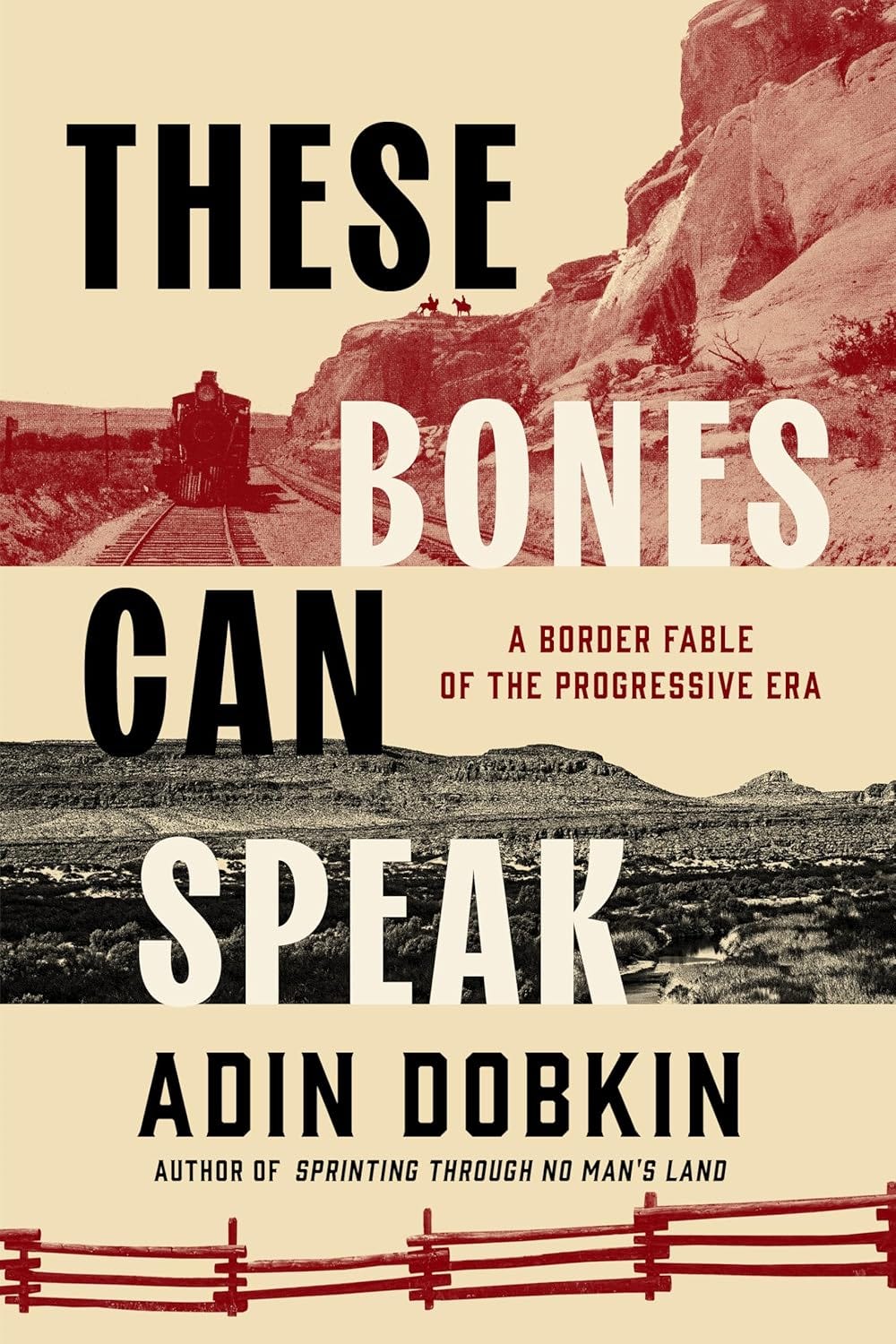
The book I obliquely discussed earlier this year (and in 2025, 2024, somehow not in 2023, and first in 2022, after a year of quiet research) has a beautiful cover designed by Kimberly Glyder and a release date. These Bones Can Speak: A Border Fable of the Progressive Era will be published by Little A on January 26, 2027. You can pre-order it from Amazon, Bookshop.org, Barnes & Noble, Books-A-Million, or from your favorite local shop.
Soon, I’ll be able to share a few others’ words about These Bones, and publicity plans as they come together. For now, though, I thought I’d tell you a bit about the book. (If you’d like to start fresh, or you’ve already heard me talk about it enough, you can skip to the “How can I help?” section.)
What’s it about?
In a sentence, These Bones tells the story of José Tomás Canales and his investigation into the Texas Rangers.
Canales was something of a political wünderkind in Texas in the early years of the 20th century: the scion of a New Spanish ranching family, the only Tejano elected to the statehouse, and a reformer who represented a conservative stronghold of the state. A journalist for the Austin American wrote that the 40-year-old would soon be on his way to the capitol’s more exclusive chamber.
In the opening days of the 36th session, Canales introduced H.B. 5, a measure he co-authored with a representative from Corpus Christi. The pair’s bill sought to make minor reforms to the Texas Rangers, the state’s law enforcement agency. Canales thought the Rangers obviously needed more stringent regulations, but so far he had avoided making public statements against them. He’d much prefer it if James Harley, the adjutant general, or William Hanson, the Rangers’ special investigator, quietly and promptly discipline the men responsible for the killing of Mexican laborers and small landowners, including the massacre at Porvenir, when boys as young as sixteen and men as old as seventy-two were lined up and shot down along the Rio Grande by Rangers in Company B.
To Canales, the events that followed his introduction of H.B. 5 were anything but obvious. James Harley called for an investigation into the Rangers, a step the legislator thought unnecessary. At the same time, Harley asked Canales’s peers to determine why he had authored H.B. 5. Though the First World War was over, radicalism remained a force in the United States. His fellow legislators could not honestly claim that Canales was on a political edge, but in the following weeks he nonetheless had to defend himself while also acting as the de facto prosecutor of the unit. This stretch exposed a fragment of the Rangers’ depths, as well as Canales’s naive understanding of the unit’s role and that of reform within Texas.
To try to understand how Canales came to act, as well as how he failed, These Bones goes way back. By following Canales’s ancestors like Juan Cortina, the famed outlaw-cum-rebel, I tell a story of land and labor and reform and radicalism along the border, leading up to the 36th Regular Session. These Bones is a story of political imaginations in the U.S. and Mexico, those both revealed and repressed. It’s a bit of an odd duck—one part multigenerational border story, another part historical essay, another part political biography—but I think it achieves what I set out to do, and it’s at least honest in its content and form.
What’s the story behind the book?
Not too long ago, I wrote an essay about nonfiction’s production that included some details about These Bones’s drafting, revising, and editing. What the essay didn’t talk about much was the book’s form.
These Bones started rather straightforwardly. I wanted to tell the story of Canales’s two weeks investigating the Rangers: the witnesses who appeared before the committee and the violence they recounted. I wanted to contextualize the relationships that bound the figures in the room as the transcripts only hinted at. I wanted to discuss the landowners advantaged by the presence of Rangers and the sheriffs and political bosses whose rule was threatened by them. I wanted to talk about Canales’s former enemies who came to support him, and the allies who turned their backs.
Already I had uncovered details about the named incidents that Canales had not, largely thanks to historical distance. Through months and years of archival research, I began to know something of the other subjects, as well as the Rangers’ internal practices.
At the same time, a gap remained in my understanding of the legislator. I didn’t fully comprehend why Canales acted as he did: why he risked his life and career to reform the unit at the same time that he pulled his punches with their leaders. Absences in the record and in my own knowledge delivered me to a more historically distant location than I first planned. Some elements of this book will likely cover familiar territory; it takes readers quite a few pages to get to the investigation itself, so that strata can be laid. I wanted to replicate my own process of discovery, in time coming to a place contingent and derived from longstanding forces.
Is These Bones anything like Sprinting?
In its interest in the experience of an individual and the society that surrounds him: yes. In its interest in geography and the memories conjured up by that geography: yes. In its style of writing: more or less, though there are more different modes in this book than in Sprinting.
That book was a rather straightforward work of historical journalism, even if it described earlier eras via the passing geography of the 1919 Tour de France, and had a wider interest in the act of post-war rebuilding. It wasn’t just about the bike race, but at the end of the day, I didn’t have to puzzle through much by the time I was onto drafting: the research was done and the motivations of the cyclists and Henri Desgrange were reasonably clear.
These Bones is more essayistic. I grapple with Canales and his actions. I try to map his decisions onto our contemporary world. How should a political actor behave when confronted with untenable circumstances? Throughout the process of drafting and revising, my thoughts about Canales shifted and were subtly enhanced. With how little the legislator wrote about his political career, I don’t get all the way there. I get pretty close, maybe, but I can’t say that with certainty.
How can I help?
I’m glad you asked! In its length, subject matter, and slightly odd form, this book will need your help to find its readers. Don’t get me wrong, after you pick These Bones up, I think you’ll like it. It’s just not the sort of book that’s often published these days and there’s not enough space on the jacket to share what I just did. As such, These Bones could use some hand selling.
If you’re a reader, I hope you’ll preorder a copy of These Bones from your preferred shop. As you might have heard, preorders are how publishers understand interest in a forthcoming title and scale up or down their efforts accordingly. I also hope that you’ll request a copy for your local library.
In fact, I don’t care how you read These Bones: buy it, borrow it, steal it—I’m more interested in the story being out there and talked about than having a certain number of sales (though at some point I will need money to write another). I know you don’t have a lot to work from yet, but if the story sounds interesting, I’d be grateful if you share this post or the others I’ve started to put up on Twitter and Instagram. If you have a book club, I hope you’ll consider These Bones, too—I’m happy to hop on a call to discuss it with whomever.
Lastly, if you’re a critic, interviewer, events coordinator, bookseller, or someone else who regularly engages with books or history (or are friends with that person), drop me a line. I’d love to get you a galley, or speak with you or others as we get closer to launch. Thanks for your time, and I hope you enjoy the book.
Thx Adin. I ordered it from Pulp Fiction in Vancouver. Looking forward to reading it. Cheers, Bruce
booktok it